 Superfocus
Time Blocking Timer
Meetings have slots. Deep work gets "whenever." By Friday you've been busy all week and shipped nothing that matters.
The stall
- Calendar packed. No blocks for you.
- Reactive all day. Proactive never.
- Week ends. Big project untouched.
The block
- Block 25 minutes. Protect it like a meeting.
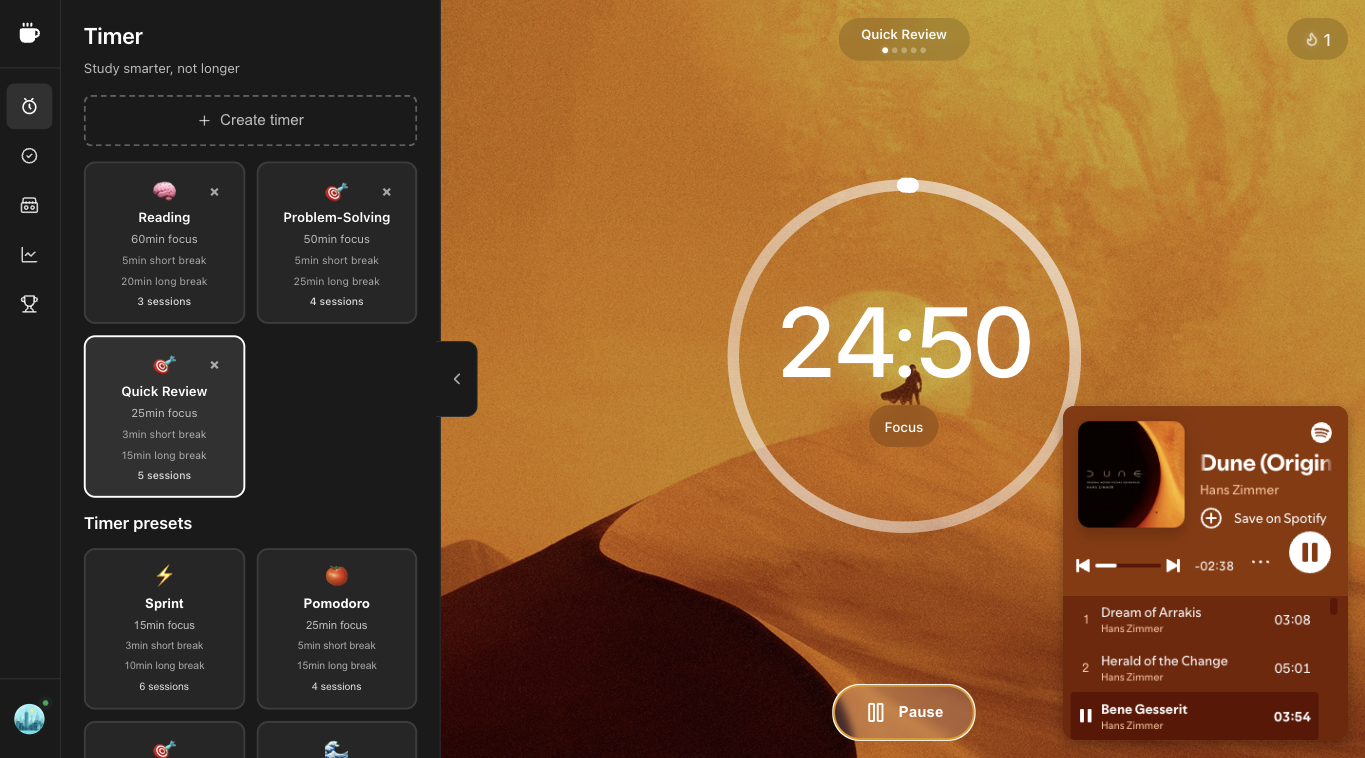
- Timer + tasks in one app.
- Your time, on your terms.
Suggested Superfocus preset: Custom timers + task list
How to run a time blocking session
- Name one outcome. “Study chapter 4” or “write the intro,” not “be productive.” Vague tasks are why people search how to focus and still open Slack.
- Pick Custom timers + task list. If starting feels heavy, cut the block in half. A finished 15-minute sprint beats a abandoned 25-minute pomodoro.
- Start the Superfocus timer and optionally a cassette (lofi, rain, white noise) in the same tab. Do not open a second “study with me” video.
- When it rings, stand up. The break is part of the pomodoro technique, not optional chrome. Then start the next block or stop for the day.
Where time blocking sits among other rhythms
The pomodoro technique (25 on / 5 off, longer break after four) is the default because search volume and habit already point there. Flowtime and 45-minute blocks exist for writing and code. Deep work (about 90 minutes) is for problems that need warm-up. Sprint and 10–20 minute custom timers exist because ADHD and task paralysis are start problems, not “discipline” problems.
Use this page’s preset as a hypothesis. Run three sessions. If you quit early, shorten. If the bell kills flow, lengthen. Superfocus stores custom durations so you are not stuck with someone else’s tomato.
Mistakes that make time blocking timer feel useless
- Stacking three tools: a tomato timer, Spotify, and a task app. Context switching is the product.
- Skipping breaks until you crash. Cirillo’s pomodoro technique uses 5-minute pauses on purpose.
- Judging the day by hours in a chair instead of finished blocks. Superfocus analytics count completed sessions, not tab time.
- Forcing 25/5 when the work is a 90-minute deep-work problem — or forcing 90 minutes when you cannot start.
Why use Superfocus instead of a kitchen timer
A kitchen timer or a silent chrome pomodoro extension only answers “when does this end?” Superfocus also holds the task, ambient sound, and a record of what you actually finished. That is the gap between a tomato timer novelty and a study timer or focus timer you will reopen tomorrow.
Related searches we designed for: pomodoro timer online, pomodoro technique timer, study timer, and focus timer — not a new productivity religion. One browser tab. $1.99/month after a 7-day trial. There is no free plan.
What Superfocus costs
There is no free plan and no guest timer. Premium is $1.99/month after a 7-day trial. Subscribe, then run time blocking at /app. If you only need a countdown, keep a kitchen timer or phone clock — do not pay $1.99/month for that.
Questions people actually ask
What is a time blocking?
Time Blocking Timer is a timed focus block you run in the browser. Superfocus keeps the clock, one task, and optional sound in the same tab so you do not bounce to YouTube or another timer.
Do I need the classic 25/5 Pomodoro?
Only if it fits the work. Superfocus ships Pomodoro 25/5, Sprint, Flow, and Deep Work. Pick the shortest block you will actually start, then lengthen once the first session finishes.
How much does Superfocus cost?
Premium is $1.99/month after a 7-day trial. There is no guest timer and no free plan. Subscribe, then use the timer at /app.
Keep going
Run this in Superfocus
One plan. $1.99/month after a 7-day trial. No free plan. Timer lives at /app after you subscribe.